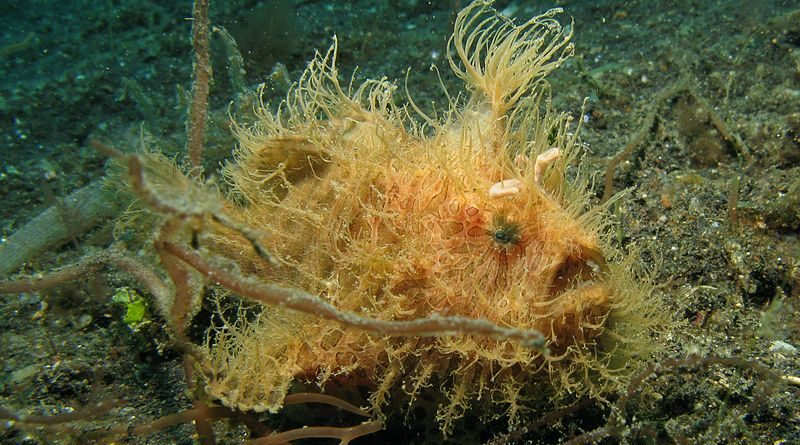
Frogfish, the master of disguise
Named due to their squat resemblance to the common amphibians, frogfish are one of those wonderful weird-looking underwater inhabitants that divers simply love to discover. They are found nearly worldwide often hiding in rocky areas and coral reefs in tropical and subtropical waters but tend to be bunched as species in different oceans. Most species live in relatively shallow waters although some species are deep dwelling. Recreational divers in Asia are most likely to spot certain species including giant, clown and painted frogfish. There is a lot of variety within species as well, two frogfish of the same species can have quite different markings and colours, making it exceedingly difficult to correctly identify many of them. Frogfish have short, stocky body with upward pointed mouth and rounded dorsal fins and tail. Their incredible variety of colour and texture make them fascinate to observe, while their behaviour is equally unusual.
Also known as members of the genus Antennarius, family Antennariidae (antennae bearing), frogfish are so well camouflaged and adapted to their immediate surroundings, that they are rarely detected. Frogfish take on many different colour forms throughout their lifecycle depends on the habitat, however, the dominant colours are white and black. All frogfish are speculated to have a chameleon like ability with some even growing hair like appendages. But unlike the chameleon, the frogfish are unable to change their colour quickly, it can take several weeks
Frogfish work on various type of camouflage to hide from predators and sneak up on prey. Some species look a lot like the colours and textures of sponges. The giant Commerson’s frogfish (Antennarius commerson), for example, can adjust its colour to blend in with pink, red, yellow, or brown sponges and rocks, and even has unevenly textured skin toned with the rugged surface of the reef. The psychedelic frogfish (Histiophryne psychedelica) has yellow, brown, and white stripes that look just like stony corals. And the hairy frogfish (Antennarius striatus) has long, waving appendages that can resemble algae or even a spiny urchin. Their disguise approach is a type of aggressive mimicry—a strategy of resembling something else to gain an advantage over the prey. This means potential prey can swim by and never see the well-hidden frogfish, allowing them to attack the prey from a close range. Frogfish are also equipped with a specialized lure called an Esca, which is a type of modified fin called an illicium that acts like a fishing rod for their prey. It can resemble a worm, shrimp or even small fish that drawn other fish and crustaceans. Once their prey is close enough, frogfish swallow it in one piece in a blink of an eye. Although they look slow and ungainly, a frogfish can attack in as little as 1/6000 of a second – the fastest movement in the animal kingdom. They can swallow prey that is twice their size thanks to the extremely flexible bones that let them expand the mouth 12 times their normal size. This carnivores’ diet is based on the fish and crustaceans, but they are also cannibalistic and will feed on others of the same species if they are starving.
There are not many other fish that divers might mistake for a frogfish, but it can be exceptionally difficult to distinguish between the sexes or species. There is no way to tell male from female. Since colouration is a useless method of identification for all but the rarest species, one should be looking out for species-specific features such as what form the lure takes the number of eye spots and the number of spines.
Frogfish are fairly small in size—full grown frogfish vary from the New Ginean frogfish (Antennatus dorehensis) only 5 centimetres to the Commerson’s frogfish that can reach 50 centimetres. This exceptional underwater lie-in-wait predator have modified pectoral fins that resemble legs, which allow them to “walk” along the ocean floor. As a juvenile the Giant frogfish may be white or yellow and saddled with reddish coloured patches, often misidentified underwater as a clown frogfish. But as they grow towards the sex phase the colours can shift from pink, yellow, black, beige, green and more, often sporting scab like appendages. Adult frogfish are usually seen living around sponges to a depth of 75 meters, although more often seen at a depth of 15 meters on average.
There are 45 species of frogfish in which most of them, such as the hairy frogfish, are not poisonous. They are a solitary creature, but they can be found with other frogfish during the mating season. Both male and female release their reproductive cells during fertilization. As female frogfish becomes ready to mate, they start producing eggs. They can produce 40,000 to 180,000 per season. As her abdomen swells, she becomes larger and more buoyant, attracting the attention of nearby males. As her buoyancy increases the male starts to nudge her repeatedly until both float to the surface where the eggs are released and fertilised, forming a floating ribbon-like shaped gelatinous raft. This raft is usually left to float pelagically, however some species attach the eggs to their bodies and guard them until they hatch. In Raja Ampat it is possible to find the Marble-Mouthed Frogfish (Lophiocharon lithinostomus) where the female of this special frogfish carries her clutch of eggs against the side of her body. Juvenile frogfish are pelagic for about 2 months once hatched, after which they settle on a reef. While some frogfish guard the eggs until they hatch, other species of frogfish do not show parental care.
Frogfish can suck in water and puff up their bodies, making them too large for most predators to swallow. But their best defence is its camouflage. Not only is it essential for catching prey, but it also helps baffle would be predators. Most of their potential predators, such as moray eels, have great difficulty in picking out a frogfish from the surrounding habitat unless they move. Frogfish do not swim very much but they can, and it is pretty amazing to watch. They use jet propulsion to swim; water gets sucked in through their mouth and then pushed out through the gill openings. It works pretty well, at least for short distances. They do not seem to have brakes, so when it comes to stopping, they just glide into position or bump into an object to stop.
There is very little empirical data about the life cycle of a frogfish. Most of the available data on marine animals comes from fisheries — not a place where many anglerfish are to be found. It is difficult to imagine that they live beyond a few years. Certainly, their life span in captivity is only a matter of a few years. In the wild, with the uncertainties of food sources and parasites, it is unlikely to be much longer. Their greatest threats are loss of habitat and ocean pollution but despite that, wild population of frogfish is still large and stable.
Divers and underwater photographers love frogfish, but what keeps this unique creature so attractive is certainly not their grumpiest looks. Part of the thrill of frogfish is undoubtedly in the hunt – these masters of camouflage give divers a sense of accomplishment merely by being detected.